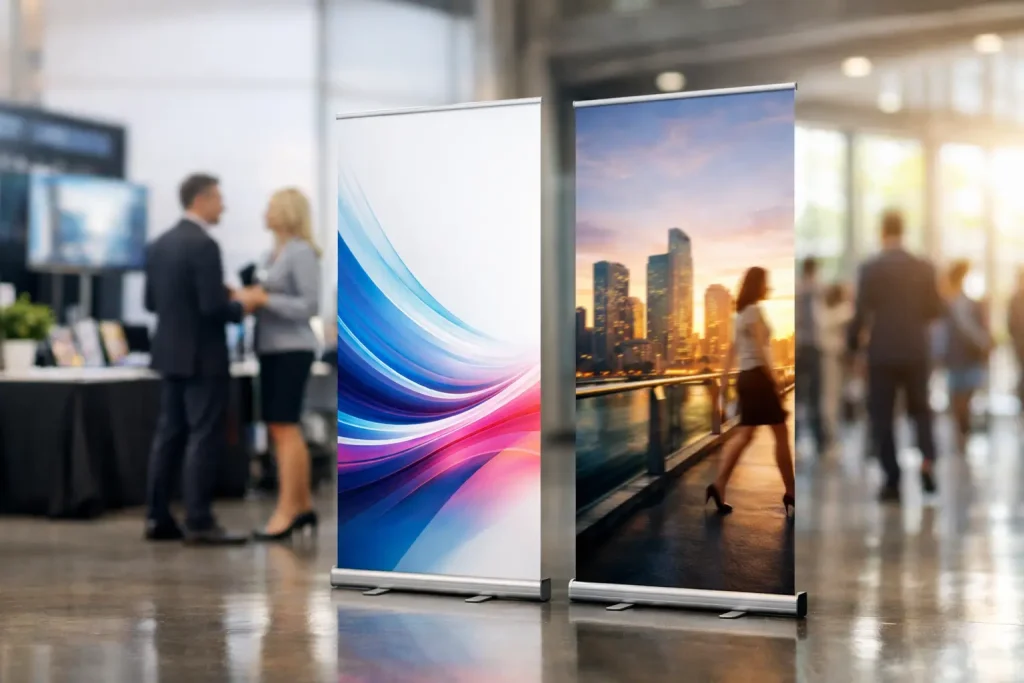
You usually notice a roller banner when it is either doing its job perfectly or doing it very badly. At a trade show, in a reception area or beside a sales counter, it has a few seconds to say who you are, what you offer and why someone should care. That is why roller banner printing is less about buying a display stand and more about choosing a piece of marketing that needs to work hard in a small space.
For many businesses, schools, charities and event organisers, roller banners are one of the most cost-effective display products you can buy. They are portable, quick to set up and easy to reuse. Just as importantly, they help smaller organisations look organised and professional without stretching the budget.
Why roller banner printing still works
Digital marketing gets most of the attention, but physical spaces still matter. If you meet customers face to face, attend exhibitions, run local promotions or welcome visitors into your premises, people are making quick judgements before anyone says a word. A roller banner helps shape that first impression.
It works because the format is simple. You pull it up, position it where footfall is strongest and your message is visible straight away. There is no complicated installation and no need for wall fixing. For businesses that need practical marketing materials rather than elaborate display systems, that simplicity is a real advantage.
There is also a value argument. A well-designed banner can be used again and again across open days, conferences, retail promotions, pop-up stands and community events. Compared with one-off signage, roller banners often give better mileage, especially if your core message stays consistent.
Where roller banners make the biggest impact
The best use of a roller banner depends on the setting. In an exhibition hall, it often acts as a stop-and-scan display. People walking past need to understand your offer in seconds. In a reception area, the same banner can reinforce trust by showing services, accreditations or key contact details.
Retail spaces use them differently. There, a banner might promote a limited offer, a seasonal range or a finance option. Schools and charities often use them at enrolment events, fundraising days and community meetings because they are easy to carry, store and reuse. Tradespeople and local service firms also get good value from them for showroom spaces, supplier counters and local fairs.
That flexibility is one of the main reasons roller banners remain a staple product. They suit businesses that do not have time for complicated display planning.
Choosing the right roller banner printing option
Not every banner needs the same specification. If you only use it a few times a year at local events, a standard unit is often the sensible choice. It keeps costs down and still delivers a clean, professional result. If you travel regularly to exhibitions or need a smarter finish for repeated use, it can be worth stepping up to a premium model with a sturdier base and better long-term durability.
Size matters too, but bigger is not always better. A standard width is often enough for entrances, reception spaces and shell scheme stands. Wider banners can make more impact, though they need more floor space and can look crowded if the artwork is not handled properly. The right choice depends on where the banner will sit and how far away people will view it from.
Material and print quality also affect the result. Good roller banner printing should produce sharp text, solid colour and graphics that do not look washed out under indoor lighting. If your design relies on photography, gradients or brand colours, consistency matters. A cheap-looking print can undermine a professional message very quickly.
How to design a banner people actually read
The most common mistake with roller banners is trying to say too much. Many buyers treat the artwork like a leaflet and fill every inch with text. In practice, people read banners while walking, waiting or glancing across a room. They are not standing there ready for a full brochure.
A strong banner usually starts with one clear headline. That headline should tell people what you do or what you are offering. Under that, use a short supporting line or two, then a small number of visual cues such as product images, service icons or a strong brand graphic. Your logo should be visible, but it should not be the only thing doing the work.
Contact details need some thought. If the banner is going in your own premises, a website or phone number may be enough. If it is for exhibitions, adding a short call to action can help, such as asking people to speak to your team, request a quote or ask for a sample. What matters is clarity. If someone can understand the message in three seconds, the banner is doing its job.
Keep key content high on the banner
The lower part of a roller banner is often less visible, especially in busy venues where tables, bags or passing foot traffic can block the bottom area. That means your headline, logo and main offer should sit in the upper and middle sections. Important information placed too low may never be seen.
Use fewer words and larger type
If text looks too small on screen, it will usually be too small in print as well. Keep wording tight and use type that can be read from a distance. Fancy fonts often create more problems than they solve. Clean, bold and legible usually wins.
Common roller banner printing mistakes to avoid
Poor artwork setup is one of the main causes of disappointing results. Low-resolution images, unclear branding and weak contrast can all make the final banner look flat. If your brand colours are central to how customers recognise you, they need to reproduce cleanly and consistently.
Another issue is message overload. Businesses often try to include every service, every accreditation and every selling point on one banner. The result is clutter. A banner is not there to explain everything. It is there to start the conversation or support the space it is in.
There is also the question of context. A banner designed for an exhibition may not be right for a retail counter, and a reception banner may not suit an outdoor-facing entrance area. The environment should shape the message. If you use the same artwork everywhere, it may feel generic rather than useful.
When a roller banner is the right choice – and when it is not
Roller banners are ideal when you need something portable, presentable and quick to deploy. They are especially useful for temporary setups, multi-location use and events where setup time is limited. If you want professional display material without paying for a large exhibition system, they are often the practical middle ground.
That said, they are not the answer to everything. In high-wind outdoor settings, they are the wrong product. For long-term fixed signage, wall graphics, boards or permanent display panels may be better value. If your message changes every week, a printed banner may not be as flexible as digital signage. It depends on how often you use it, where you use it and how permanent the message needs to be.
For most everyday commercial use, though, roller banners strike a useful balance between price, convenience and visual impact. That is why they remain a reliable choice for organisations that need straightforward display products that arrive on time and look the part.
Getting better value from your order
If you are investing in roller banner printing, think beyond the immediate event. A good design can support months or even years of use if it focuses on your core offer rather than a short-lived promotion. That makes the spend easier to justify and helps you get more return from a single order.
It also helps to order with practicality in mind. If you are coordinating several marketing materials at once, such as flyers, posters or leaflets for the same campaign, keeping the branding aligned will make your setup look more polished. Buyers often overlook this, but consistency across print materials can make a small business look much more established.
A dependable supplier matters as much as the product. Clear artwork guidance, fair pricing, quick turnaround and responsive support all reduce the chance of wasted time or costly errors. That is especially important when events are booked, deadlines are tight and there is no room for last-minute surprises. Conkea is built around exactly that kind of straightforward ordering experience.
The best roller banner is not the one with the most design tricks or the biggest footprint. It is the one that says the right thing, in the right place, without making your day harder than it needs to be.